


Building a new website is an exciting venture for any business or individual. However, one of the first and most pressing questions that arises is: “How much does a web developer charge per website?” The answer, much like the process of website development itself, isn’t a simple fixed price. It’s a spectrum, influenced by a multitude of factors that we’ll explore in this comprehensive guide.
Understanding these variables will empower you to make informed decisions and budget effectively for your next online project.
The Major Factors Influencing Web Development Costs
Several key elements dictate the price tag of a website. Thinking about these upfront can help you articulate your needs to a developer and get a more accurate quote.
1. Website Type and Complexity
This is arguably the most significant factor. A simple, one-page informational site will naturally cost far less than a complex e-commerce platform or a custom web application.
- Simple Informational / Brochure Websites (Small Business Website): These typically have 5-10 pages, basic contact forms, and don’t require advanced functionality. They focus on establishing an online presence.
- Medium-Sized Business Websites: Often include more pages, content management systems (CMS) like WordPress, advanced contact forms, image galleries, and potentially blog functionality.
- E-commerce Websites (Online Store Development): These are significantly more complex, requiring product catalogs, shopping carts, payment gateway integrations, user accounts, order management, and robust security features.
- Custom Web Applications: Think social networks, booking systems, or specialized industry tools. These are built from the ground up to meet unique requirements and involve extensive custom coding.
2. Features and Functionality
Every extra bell and whistle adds to the development time and, consequently, the cost.
- Basic Features: Contact forms, image sliders, social media integration, basic SEO setup.
- Advanced Features: Blog setup, user registration/login, payment processing, third-party API integrations (e.g., CRM, email marketing), custom animations, multilingual support.
- Interactive Elements: Quizzes, calculators, interactive maps.
3. Design Complexity (Custom Design vs. Templates)
The visual appeal and user experience (UX) are crucial.
- Template-Based Design: Using off-the-shelf themes (e.g., WordPress themes, Shopify templates) is more affordable but offers less uniqueness. Customization is limited.
- Semi-Custom Design: Starting with a template but heavily customizing its layout, styling, and functionality.
- Full Custom Design: A unique design created from scratch by a UI/UX designer specifically for your brand. This includes wireframing, mockups, and multiple revision rounds, significantly increasing the investment.
4. Content Creation and Migration
Do you have all your website content (text, images, videos) ready?
- Client-Provided Content: The most cost-effective option, assuming the content is high-quality and organized.
- Developer-Assisted Content: The developer might help structure content, source stock photos, or provide guidance.
- Professional Content Creation: Hiring copywriters, photographers, or videographers will be an additional cost but often yields better results.
5. Developer’s Experience and Location
Like any skilled professional, a web developer’s rates often reflect their experience, expertise, and geographical location.
- Freelancers (Entry-Level to Senior): Rates vary widely based on skill level and portfolio.
- Small Agencies: Typically offer a broader range of services and can handle larger projects.
- Large Agencies: Often work with bigger budgets and provide comprehensive services, including marketing and ongoing support.
- Geographical Location: Developers in regions with a higher cost of living generally charge more. Outsourcing to countries with lower labor costs can be an option, but communication and quality assurance are key considerations.
Average Web Development Cost Ranges (Estimates)
While it’s difficult to give exact figures without specific project details, here are some broad website development cost estimates to help you benchmark:
Basic 5-10 Page Informational Website: `
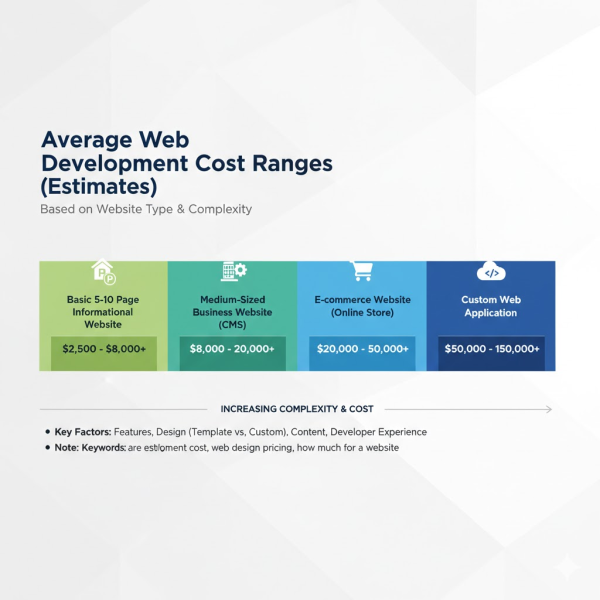
Typically ranging from $2,500 to $8,000+. Ideal for small businesses needing an online presence.
- Medium-Sized Business Website (CMS-driven with blog): Expect to pay between $8,000 and $20,000+. These offer more functionality and custom branding.
- E-commerce Website (Online Store): Costs generally start from $20,000 and can go up to $50,000+ for complex stores with extensive product inventories and custom features.
- Custom Web Application Development: These are the most expensive, often starting from $50,000 and reaching $150,000+, depending on the scale and complexity of the application.
Note: These are estimates. Always get detailed quotes for your specific project.
Beyond the Initial Build: Ongoing Costs
Remember, a website isn’t a “set it and forget it” investment. There are crucial ongoing costs:
- Domain Name Registration: Annual fee (approx. $10-$20).
- Web Hosting: Monthly or annual fee (from $10/month for shared hosting to hundreds for dedicated servers).
- SSL Certificate: Essential for security and SEO (often included with hosting, or $50-$200 annually).
- Website Maintenance and Updates: Security patches, software updates, content changes. Many developers offer website maintenance packages (monthly fees varying from $50 to $500+).
- Marketing and SEO: Ongoing efforts to drive traffic and rank on search engines are vital for long-term success.
How to Get an Accurate Web Development Quote
To get the most precise estimate for your project, clearly define your needs:
- Outline Your Goals: What do you want your website to achieve? (e.g., generate leads, sell products, provide information).
- List Required Features: Be specific. Do you need a blog? An online booking system? A photo gallery?
- Provide Examples: Show developers websites you like (and dislike) for design and functionality inspiration.
- Define Your Budget (If Comfortable): This helps developers tailor solutions within your financial parameters.
By understanding the factors that influence web development pricing, you can confidently approach developers and ensure your investment aligns with your business goals. Don’t just look for the cheapest option; seek value, expertise, and a partner who understands your vision for a successful online presence.